

An employee clocks in for a coworker who hasn’t arrived. Another adds 30 minutes to a shift they never worked. These discrepancies might seem minor on individual timesheets, but across an entire workforce, they can quietly increase payroll costs and undermine the accuracy of employee attendance records.
Timesheet fraud is the deliberate misrepresentation of working hours for financial gain. Whether through inflated timesheets, buddy punching, or falsely reported overtime, these practices can be hard to detect, especially for businesses that rely on manual timekeeping or manage employees across multiple locations.
For organizations with hourly employees and complex shift schedules, understanding how timesheet fraud occurs is an important step toward protecting labor budgets and maintaining accountability. Let’s explore common types of timesheet fraud, their impact on businesses, and strategies to prevent them.
What Is Timesheet Fraud?
Timesheet fraud refers to deliberately falsifying employee time records to claim pay for hours not actually worked. It can take several forms, from exaggerating shift lengths to having another employee clock in on someone’s behalf.
Distinguish intentional fraud from ordinary timekeeping mistakes. Missed punches, incorrect entries, and payroll discrepancies are not necessarily fraudulent, but they still highlight the importance of accurate attendance records.

For organizations managing large, hourly, or geographically dispersed workforces, consistent time tracking helps maintain accountability and provides greater visibility into labor costs.
Common Types of Timesheet Fraud
Although timesheet fraud can take many forms, three common examples are inflated work hours, buddy punching, and misreported overtime.
1. Inflation of Work Hours
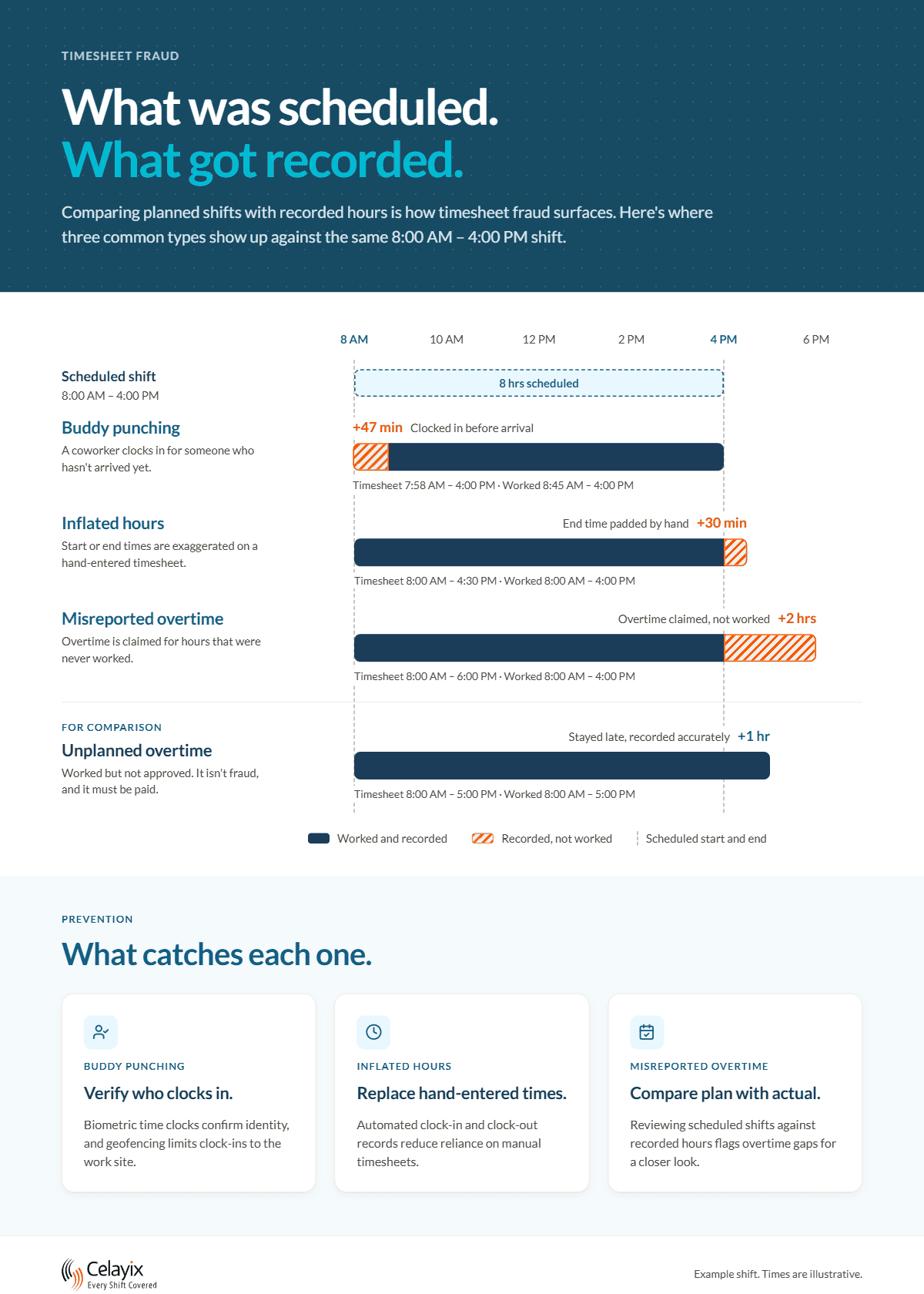
Inflating work hours occurs when employees intentionally report more time than they worked. This might involve adding extra minutes to a shift, exaggerating start or end times, or submitting inaccurate timesheets.
Manual timekeeping systems, including paper timesheets and spreadsheets, can make these discrepancies harder to identify when records are not independently verified.
Digital time-tracking solutions can reduce reliance on manual entries by recording employee clock-in and clock-out activity. Technologies such as biometric time clocks can provide an additional layer of identity verification.
2. Buddy Punching
Buddy punching occurs when one employee clocks in or out for another. For example, an employee might record a colleague’s attendance before that colleague arrives at work.
This practice can create inaccurate attendance records, conceal absences, and result in payment for time that was not worked.
Businesses can address buddy punching through stronger employee verification processes. Biometric time clocks help verify who is recording attendance, while geofencing technology can restrict clock-ins to designated work locations.
Together, these tools can help organizations improve the reliability of employee attendance records.
3. Misreported or Unauthorized Overtime
Overtime is another area where inaccurate time reporting can affect labor costs. Fraud may occur when employees knowingly claim overtime hours they did not work or intentionally falsify their attendance records.
However, working unauthorized overtime is not automatically timesheet fraud. Employees must still be compensated for hours actually worked in accordance with applicable employment laws.
For businesses with complex shifts and changing staffing requirements, accurate attendance tracking and overtime visibility can help identify unusual patterns and support fair, consistent scheduling decisions.
Why Timesheet Fraud Matters to Businesses
The impact of timesheet fraud goes beyond individual payroll discrepancies. Over time, inaccurate records can affect workforce planning, labor budgets, employee trust, and operational efficiency.
For shift-based organizations, reliable attendance information matters because scheduling and payroll decisions often depend on knowing who worked, when they worked, and for how long.
Accurate timekeeping also supports regulatory compliance. For example, the U.S. Department of Labor’s recordkeeping requirements emphasize maintaining accurate records of hours worked and wages earned for employees covered by applicable federal requirements.
Consistent timekeeping practices help businesses reduce discrepancies while ensuring employees receive appropriate compensation.
How Can Businesses Reduce Timesheet Fraud?
Preventing timesheet fraud requires clear workplace policies, appropriate supervision, and reliable time-tracking technology.
Several practices can help organizations strengthen their timekeeping processes:
- Establish clear timekeeping policies: Ensure employees understand how to record their hours, report missed punches, and request timesheet corrections.
- Use digital time-tracking systems: Automated clock-in and clock-out records can reduce manual entry errors and improve attendance visibility.
- Introduce employee and location verification: Biometric time clocks and geofencing can provide additional safeguards against unauthorized time entries.
- Review attendance and overtime records: Regularly comparing scheduled shifts with recorded hours can help managers identify discrepancies that require investigation.
- Maintain transparent processes: Clear approval procedures, employee communication, and appropriate privacy safeguards can reinforce accountability and trust.
While no single technology can eliminate every instance of timesheet fraud, combining these practices can make time records more consistent, reliable, and easier to manage.
How Celayix Supports Accurate Employee Time Tracking
Celayix offers time and attendance software designed to help businesses track employee working hours, manage attendance, and streamline workforce operations.
With mobile clock-ins, GPS-verified geofencing, compatible biometric time clocks, and attendance reporting, organizations can strengthen timekeeping and gain better visibility into employee work hours.
Celayix also connects workforce scheduling with time and attendance information, allowing managers to compare planned shifts with actual hours worked and monitor overtime.
By reducing dependence on manual timesheets and making attendance information more accessible, businesses can improve payroll accuracy, strengthen accountability, and make more informed workforce decisions.
Reduce Opportunities for Timesheet Fraud
Timesheet fraud can create financial and operational challenges, particularly for businesses managing hourly employees, rotating shifts, and multiple work locations.
Understanding the common types of timesheet fraud is an important first step toward prevention. By combining clear policies, regular attendance reviews, and reliable time-tracking technology, organizations can reduce opportunities for inaccurate reporting while promoting fairness and accountability.