Shift conflicts are one of the most frustrating problems in workforce management.
An employee gets scheduled during approved time off. Someone is assigned to two locations at once. A worker is available but lacks the required qualifications for the job. Then a last-minute callout forces a manager to scramble for coverage.
For organizations managing large, distributed, or shift-based workforces, these issues can quickly become expensive and time-consuming.
That is where AI scheduling can help.
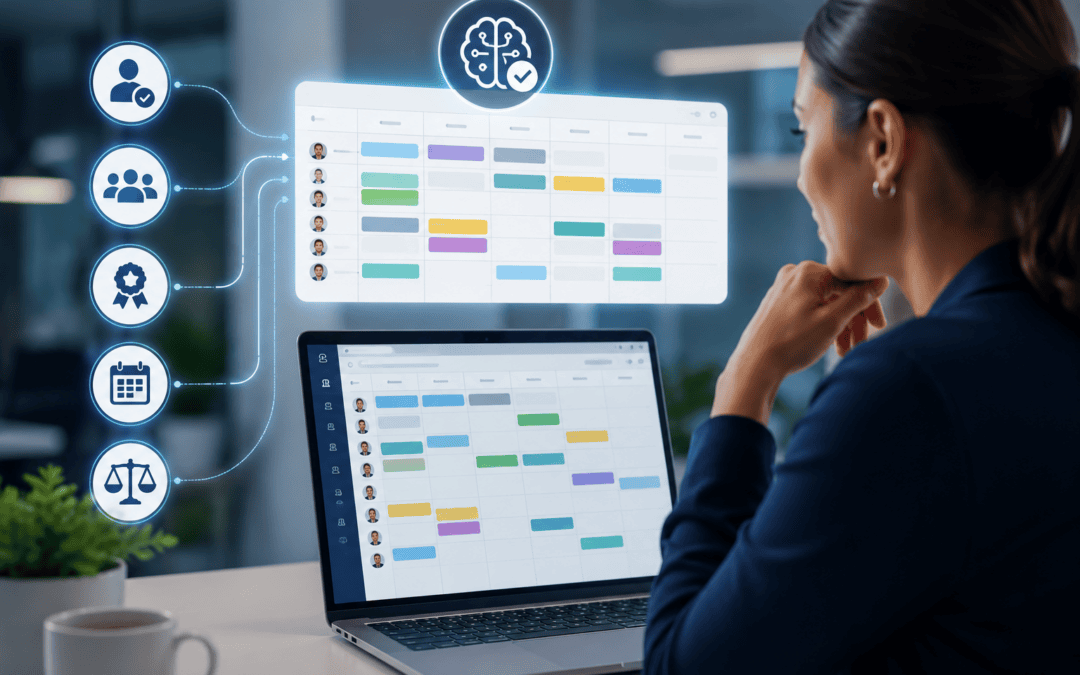
AI-powered scheduling tools can evaluate factors such as employee availability, existing assignments, qualifications, time-off requests, overtime, and staffing rules before assigning shifts. Rather than relying entirely on spreadsheets, memory, and manual checks, managers can use technology to identify potential conflicts earlier.
AI scheduling does not eliminate every workforce challenge. Employees still call in sick, demand changes, and unexpected situations arise. But it can reduce avoidable errors and make unavoidable problems easier to solve.
Here are seven ways AI scheduling can help reduce shift conflicts.
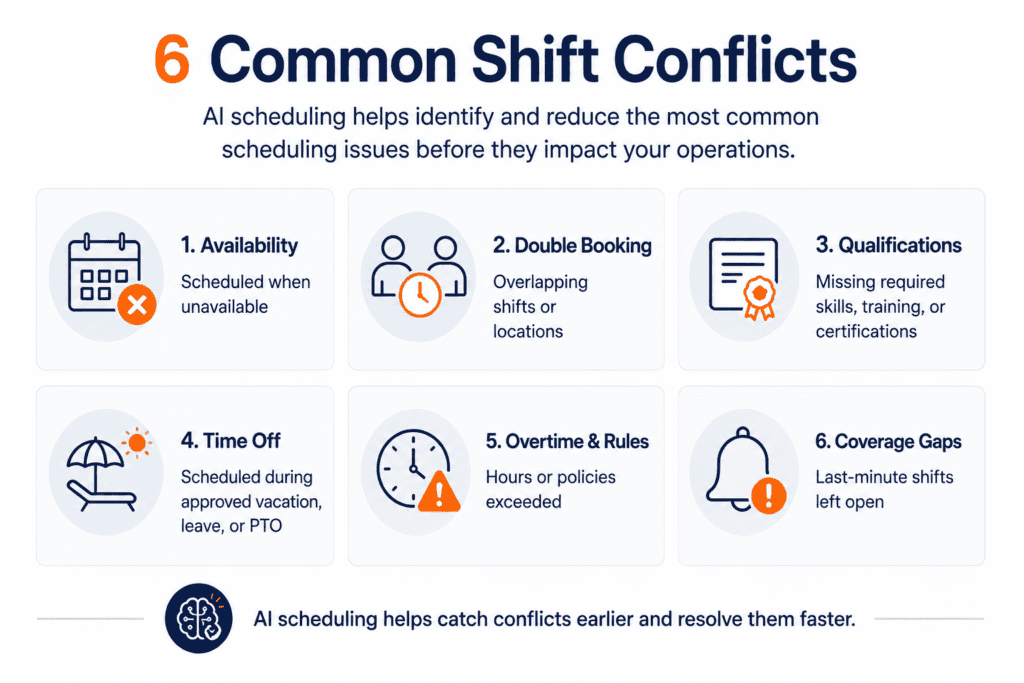
1. AI Scheduling Checks Employee Availability
One of the simplest causes of a scheduling conflict is assigning someone when they cannot work.
In manual scheduling environments, employee availability may be spread across spreadsheets, emails, messages, forms, and conversations. If that information is not kept up to date, managers can easily build schedules around outdated assumptions.
AI-assisted scheduling systems can factor availability directly into the employee scheduling process.
Instead of asking, “Who do I think is available on Friday night?” managers can use current workforce data to narrow down which employees are available to work.
This is especially useful in industries where availability changes frequently, including healthcare, hospitality, security, home healthcare, and event staffing.
By catching availability conflicts before schedules are published, organizations can reduce schedule corrections and last-minute coverage problems.
2. It Helps Prevent Double Booking
Double booking is another common scheduling error.
For example, an employee may already be working at one location from 3 p.m. to 11 p.m., but accidentally get assigned to another shift that begins at 7 p.m.
A spreadsheet may not recognize the issue.
An intelligent scheduling platform can.
Automated scheduling tools can compare new assignments against an employee’s existing schedule and flag overlapping shifts before they are finalized.
That matters even more when managers are responsible for hundreds or thousands of assignments each week.
Rather than relying on someone to manually review every schedule combination, the system can perform those checks automatically.
The result is a more reliable schedule with fewer preventable errors.
3. It Matches Employees with the Right Qualifications
Availability does not always mean eligibility.
An employee may be free to work a shift but still lack a required license, certification, skill, or level of training.
Depending on the industry, a shift might require:
- A specific professional certification
- Site-specific training
- A certain job classification
- Security clearance
- Specialized equipment knowledge
- Customer-specific qualifications
This creates another potential source of scheduling conflict.
AI scheduling tools can take those requirements into account when recommending or assigning employees.
Rather than simply finding someone who is free, managers can identify workers who are both available and qualified.
This is particularly important in regulated industries, where assigning an unqualified employee may pose compliance, safety, or service quality risks.
4. It Accounts for Approved Time Off
Vacation, personal leave, and other approved absences can easily create conflicts when time-off information is separated from the scheduling process.
A manager may approve a request weeks in advance, then forget about it while building a future schedule.
An integrated scheduling system can use approved time-off data as another scheduling constraint.
If an employee is unavailable because of approved leave, the system can prevent or flag an assignment that conflicts with that absence.
This can reduce one of the most frustrating scheduling experiences for employees: being assigned to work during time off that was already approved.
It also reduces rework for managers, who would otherwise need to find another employee after the schedule has already been published.
5. AI Scheduling Can Enforce Complex Workforce Rules
Not every scheduling conflict involves overlapping shifts.
Sometimes the schedule conflicts with a policy, labor rule, customer requirement, or operational constraint.
Managers may need to consider factors such as:
- Maximum weekly hours
- Overtime thresholds
- Minimum rest periods
- Union requirements
- Staffing ratios
- Customer-specific rules
- Location requirements
- Labor budgets
Keeping track of all these factors manually becomes increasingly difficult as a workforce grows.
AI-powered and rules-based scheduling systems can evaluate multiple requirements simultaneously.
For example, a scheduling platform may identify that an employee is technically available but is approaching an overtime threshold. Another employee may therefore be a more suitable option.
In the United States, the Fair Labor Standards Act generally requires overtime pay for covered non-exempt employees who work more than 40 hours in a workweek. The U.S. Department of Labor provides more information on these requirements.
Scheduling decisions may also affect worker fatigue. OSHA notes that extended or irregular shifts can contribute to fatigue and recommends that organizations consider factors such as staffing levels, workload, and work hours when managing fatigue risks.
These are good examples of why effective scheduling is about more than simply filling open shifts.
6. It Helps Find Replacements Faster
Even the best schedule will eventually change.
An employee may become sick, experience an emergency, or be unable to work at the last minute.
When that happens, managers need to find a replacement quickly.
In a manual process, this might involve checking employee lists, reviewing schedules, verifying qualifications, and calling workers one by one.
AI can make that process more efficient.
A scheduling system can narrow down potential replacements based on criteria such as:
- Availability
- Existing assignments
- Qualifications
- Location
- Overtime exposure
- Time-off status
Instead of starting with the entire workforce, the manager starts with a smaller group of suitable candidates.
That turns AI scheduling from simply a conflict-prevention tool into a conflict-resolution tool.
The manager still makes the final decision, but technology can reduce the amount of manual searching required to get there.
7. It Makes Last-Minute Schedule Changes Easier
Workforce schedules are rarely static.
Employees call out. Clients change requirements. Events are added. Demand increases unexpectedly. Shifts run longer than planned.
Every change has the potential to create another conflict.
With a manual schedule, replacing one employee may trigger a new round of checks:
Is the replacement available?
Are they qualified?
Are they already scheduled?
Will the additional shift create overtime?
Do they have enough time to rest between assignments?
AI scheduling tools can evaluate these variables more quickly, helping managers adapt when circumstances change.
This is particularly valuable in industries where schedules change throughout the day.
The faster a business can respond, the less likely it is that a last-minute change will result in an uncovered shift, excessive overtime, or customer disruption.
The Real Value of AI Scheduling
AI scheduling does not automatically create a perfect schedule. But managers no longer have to evaluate every scheduling variable when making a decision manually.
Availability can be checked.
Double bookings can be identified.
Qualifications can be considered.
Time off can be incorporated.
Overtime and scheduling rules can be evaluated.
Replacement candidates can be narrowed down more quickly.
For a small organization with a predictable Monday-to-Friday workforce, that level of automation may not be essential.
But for organizations managing rotating shifts, multiple locations, employee certifications, changing availability, and frequent schedule updates, AI can significantly reduce administrative workload.
It also shifts the scheduler’s role.
Instead of spending as much time searching for errors and repairing schedules, managers can focus more on exceptions, employee needs, and operational priorities.
AI Scheduling Is Becoming Part of Modern Workforce Management
AI is increasingly being incorporated into workforce management tools, but the goal is not necessarily to replace the scheduler.
In many cases, its greatest value comes from helping managers make faster, better-informed decisions.
The best scheduling systems combine automation, business rules, workforce data, and human oversight.
That combination can help organizations build schedules that are more accurate from the start and easier to adjust when circumstances inevitably change.
For businesses dealing with complex shift requirements, reducing scheduling conflicts can mean fewer administrative hours, less overtime, better employee experiences, and more dependable workforce coverage.
If your organization is still managing complex schedules primarily through spreadsheets or manual processes, it may be worth exploring how modern employee scheduling software can automate more of these checks.