

Overtime can be essential when demand increases, employees call out, or a critical shift needs coverage. But when overtime becomes routine rather than exceptional, it can quickly turn into a labor-cost problem.
For organizations with large or complex shift-based workforces, effective overtime management starts well before payroll. It starts with the schedule.
Managers need to know who is available, who is qualified, how many hours each employee is already working, what overtime rules apply, and whether another employee could cover a shift at a lower cost. When that information is scattered across spreadsheets, emails, timekeeping systems, and managers’ heads, unnecessary overtime is much harder to prevent.
Scheduling software brings those decisions together. Instead of discovering excess overtime after employees have worked it, organizations can identify overtime risk while schedules are being created and adjusted.
The result is a more proactive approach to overtime management—one that protects shift coverage while helping organizations control labor costs.
What Is Overtime Management?
Overtime management is the process of monitoring, controlling, and planning employee hours to ensure overtime is used appropriately.
Good overtime management does not necessarily mean eliminating overtime.
There will always be circumstances where extra hours make operational sense. An unexpected absence, unusually high demand, emergency coverage, or a shortage of qualified employees may leave an organization with no practical alternative.
The more important distinction is between necessary overtime and avoidable overtime.
Celayix defines avoidable overtime as overtime caused by poor schedule management or a failure to make full use of available resources. Unavoidable overtime, by contrast, occurs when an organization genuinely lacks the personnel or resources needed to meet demand. You can explore that distinction further in Celayix’s guide to avoidable overtime.
Effective overtime management focuses on reducing the first category without compromising the second.
That means giving schedulers enough information to answer a simple question before assigning extra hours:
Is overtime really the best option for this shift?
Why Overtime Management Starts with Employee Scheduling
Payroll ultimately records overtime, but many overtime costs start with scheduling decisions.
Imagine an employee calls out shortly before a shift begins. A supervisor needs someone immediately, so they call the employee who usually accepts extra work. That employee is qualified and available—but they are already approaching their overtime threshold.
Meanwhile, another qualified employee has fewer scheduled hours and could have covered the same shift without triggering overtime.
The problem was not necessarily understaffing. It was a lack of visibility when the scheduling decision was made.
This becomes even more difficult across large workforces, multiple locations, union environments, or operations with specific qualification requirements. Managers may need to account for availability, certifications, seniority, location, labor cost, fatigue rules, employee preferences, and overtime at the same time.
Manual scheduling makes it hard to evaluate those variables consistently.
Effective overtime management requires making overtime part of the scheduling decision itself.
That’s where employee scheduling software can make a substantial difference. Celayix’s scheduling platform evaluates scheduling requirements such as qualifications, availability, overtime, costs, and other business rules while assigning shifts.
How Scheduling Software Improves Overtime Management
The biggest advantage of scheduling software isn’t just that it creates schedules faster. It gives managers more information and more control over the decisions that lead to overtime.
Here are seven ways scheduling technology can improve overtime management for shift-based organizations.
1. Identify Overtime Before Assigning a Shift
One of the biggest problems with reactive overtime management is timing.
If managers only review overtime after timesheets have been submitted, the organization has already incurred the cost.
Scheduling software can move that decision upstream.
Instead of asking how much overtime was worked at the end of the week, schedulers can identify when a proposed assignment is likely to push an employee beyond an established overtime threshold.
That visibility lets the scheduler explore other options before publishing or changing the schedule.
Celayix supports configurable overtime settings, including weekly overtime, daily overtime, and daily double-overtime thresholds. Organizations can also incorporate more specialized overtime configurations, depending on their requirements.
This approach changes overtime management from:
“Why did we have so much overtime last pay period?”
to:
“Can we prevent this overtime before assigning the shift?”
That is a much more useful question.
2. Find the Right Qualified Employee at the Right Cost
Preventing overtime is not as simple as choosing whichever employee has the fewest hours.
The employee still needs to be appropriate for the shift.
A healthcare organization may need a worker with a specific qualification. A security company may have licensing or site restrictions. Hospitality operations may need particular roles or skills. Unionized workplaces may also need to consider seniority, agreements, and other assignment rules.
That makes overtime management a matching problem.
The goal is to find an employee who meets the shift requirements without unnecessarily increasing premium labor costs.
Celayix’s shift management platform matches shifts with qualified employees while accounting for overtime, qualifications, labor costs, availability, and other scheduling rules.
When a manager can evaluate all those factors together, “Who can work?” becomes a more useful question:
“Who is the best qualified person to work this shift under our rules and cost constraints?”
That helps organizations reduce avoidable overtime without leaving important shifts uncovered.
3. Apply Overtime Rules Consistently
Overtime rules are not always straightforward.
In the United States, for example, the Fair Labor Standards Act generally requires covered, nonexempt employees to receive overtime pay of at least one and a half times their regular rate for hours worked beyond 40 in a workweek.
But overtime requirements can vary based on jurisdiction, employee classification, collective agreements, company policies, and other factors. Organizations should always configure their processes around the rules that apply to their workforce.
For a busy scheduling team, remembering every threshold and restriction manually creates room for error.
Rules-based scheduling helps apply those requirements consistently.
Instead of relying on individual supervisors to remember whether a specific employee is approaching overtime, scheduling rules can be incorporated into the process. Celayix, for example, supports rules involving overtime alongside qualifications, double booking, budgets, availability, union requirements, and other scheduling constraints.
That consistency matters most when multiple managers schedule employees from the same labor pool.
Without a shared system, one supervisor may not know that another location has already assigned several additional shifts to the same employee.
Centralized scheduling visibility reduces that risk.
4. Detect Overtime and Recommend a Replacement
An overtime warning is useful. Resolving the problem is better.
Modern workforce automation can take overtime management beyond simply displaying a notification.
Celayix’s current Workforce Automation capabilities can support workflows that identify overtime shifts, notify relevant managers, suggest replacement employees, or reassign shifts according to configured rules and approval requirements.
Consider a weekly schedule containing several employees who have crossed an overtime threshold.
A traditional system might produce a report.
A workflow-driven approach can instead follow a process such as:
Detect overtime → find an eligible replacement → validate the replacement against scheduling rules → request approval or make the change → record the outcome.
That turns overtime management into an operational workflow rather than another report managers have to remember to check.
Organizations can also determine how much automation they are comfortable with. Some situations may only require a notification, while others can involve manager approval before a shift is changed.
This is especially valuable in high-volume operations where reviewing every shift manually can become unrealistic.
5. Fill Open Shifts Without Automatically Falling Back on Overtime
Last-minute absences are one of the easiest ways avoidable overtime enters a schedule.
A worker calls out. The shift still needs coverage. The supervisor is under pressure, so they contact the same handful of reliable employees.
It solves the immediate coverage problem—but potentially creates a new labor-cost problem.
Better overtime management requires a faster way to see the complete pool of people who could work.
Scheduling software can help managers identify employees based on availability, qualifications, scheduled hours, and other relevant criteria rather than depending on memory or manually calling employees one by one.
Employee self-service can also expand schedulers’ options. Through the Celayix Employee App, employees can access scheduling, communication, and time-tracking from one place.
When employees and managers have a clearer way to communicate shift availability, they can address open shifts earlier and with more options.
That reduces the pressure to use overtime simply because it is the fastest solution.
6. Compare Scheduled Hours with Actual Hours Worked
A schedule might show that an employee is safely below an overtime threshold. Their actual hours may tell a different story.
Employees may clock in early, leave late, cover additional responsibilities, or work longer than the original schedule anticipated.
If scheduling and timekeeping operate independently, a manager may assign another shift without realizing the employee has already accumulated additional hours.
That’s why effective overtime management should consider both scheduled time and actual worked time.
Celayix’s Time and Attendance software connects employee time tracking with scheduling and downstream processes such as payroll.
Bringing scheduling and attendance information closer together provides managers with a more complete view of labor utilization.
It can also make it easier to investigate differences between planned and actual hours.
For example, if a particular location regularly produces more worked hours than scheduled hours, the underlying issue may not be overtime scheduling alone. Managers may need to investigate shift handoffs, clocking practices, workload, staffing levels, or the accuracy of their original labor plan.
That insight supports better overtime management over the long term.
7. Use Overtime Data to Fix Recurring Staffing Problems
Preventing one unnecessary overtime shift is useful.
Understanding why overtime keeps occurring is more valuable.
Repeated overtime can reveal larger workforce problems.
A location that consistently requires overtime every Friday may have a demand-planning issue. A particular job function may not have enough qualified employees. A department may be relying too heavily on the same experienced workers. Certain shifts may be difficult to fill.
Scheduling and attendance data allow managers to identify those patterns.
Rather than looking only at total overtime expenditure, organizations can ask:
- Which locations generate the most overtime?
- Which employees repeatedly approach overtime thresholds?
- Which positions are hardest to cover without overtime?
- Are certain days or shifts consistently understaffed?
- How often does overtime result from callouts?
- How often could another qualified employee have been assigned instead?
This is where overtime management becomes part of broader workforce planning.
Instead of treating individual overtime shifts as isolated problems, managers can address the staffing conditions that create them.
Overtime Management Should Protect Coverage, Not Just Reduce Hours
An important distinction exists between reducing unnecessary overtime and simply cutting overtime.
A strict “no overtime” policy can create its own problems if shifts remain uncovered.
For many shift-based organizations, coverage has real consequences. A missed security post can create risk. An unfilled caregiver shift affects patient care. Missing hospitality staff can impact guest service. An understaffed event can disrupt operations.
The objective should therefore be controlled overtime, not zero overtime at any cost.
Some overtime will be necessary.
The goal is to ensure managers reach that decision after evaluating the available alternatives.
When no qualified employee can fill an important shift without entering overtime, paying overtime may be exactly the right operational decision.
Good overtime management makes that choice intentional, not accidental.
Better Overtime Management Can Also Help Address Fatigue Risk
Labor cost is an obvious reason to monitor overtime, but long or irregular work schedules can create another concern: fatigue.
The National Institute for Occupational Safety and Health (NIOSH) notes that workplace fatigue is commonly associated with nonstandard schedules, including night shifts and extended work hours. Fatigue can slow reaction times, reduce attention and concentration, and impair judgment.
This does not mean every employee who works overtime will experience dangerous fatigue. Fatigue has many potential causes, and scheduling is only one.
However, organizations operating around the clock should consider work hours when designing scheduling policies.
That makes overtime management relevant not only to payroll but also to broader workforce planning.
Managers who can see employee hours and scheduling patterns are better positioned to avoid repeatedly assigning extended hours to the same workers when suitable alternatives exist.
For more guidance on work-related fatigue, see NIOSH’s Fatigue and Work resources.
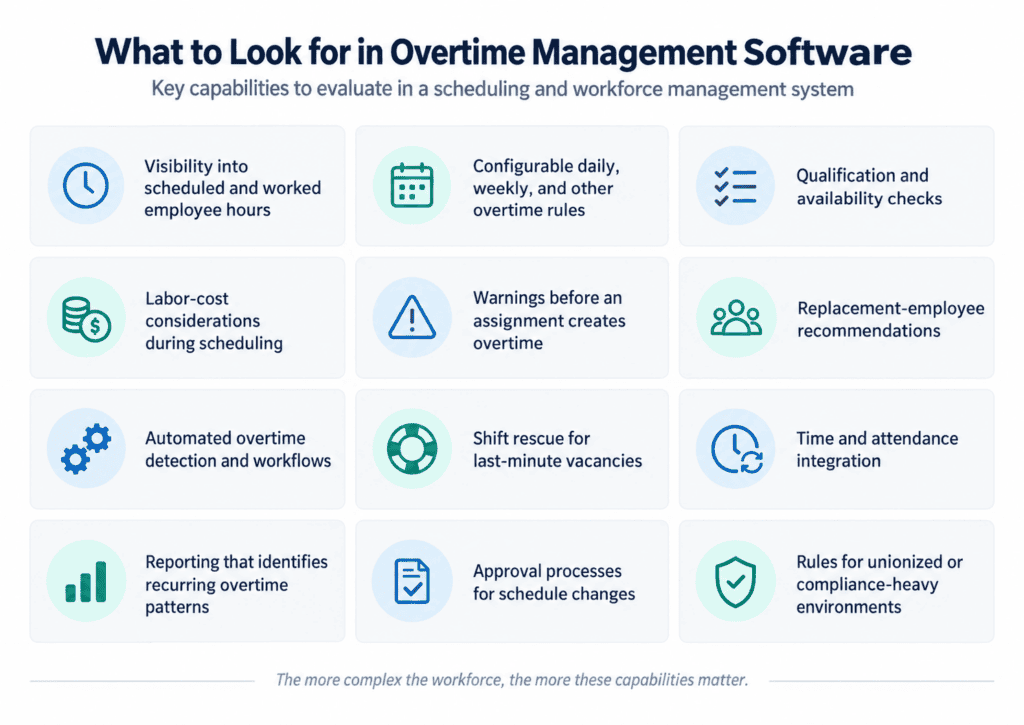
What to Look for in Overtime Management Software
Not every employee scheduling system provides the same level of overtime control. Organizations evaluating scheduling technology should look beyond basic calendar functionality.
Useful overtime management capabilities include:
- Visibility into scheduled and worked employee hours
- Configurable daily, weekly, and other overtime rules
- Qualification and availability checks
- Labor-cost considerations during scheduling
- Warnings before an assignment creates overtime
- Replacement-employee recommendations
- Automated overtime detection and workflows
- Shift rescue capabilities for last-minute vacancies
- Time and attendance integration
- Reporting that identifies recurring overtime patterns
- Approval processes for schedule changes
- Rules for unionized or compliance-heavy environments
The more complicated the workforce, the more important those capabilities become.
A simple scheduling calendar may be enough for a small operation with predictable shifts. A large, distributed workforce with hundreds or thousands of shifts needs a system that can evaluate multiple scheduling constraints simultaneously.
How Celayix Supports Better Overtime Management
Celayix treats overtime as part of the complete shift-management process, not something organizations discover only after payroll is processed.
Its rules engine can apply overtime alongside qualifications, availability, union requirements, double-booking restrictions, and other organizational policies when making scheduling decisions.
Celayix’s scheduling tools help managers find appropriate employees for shifts while considering labor costs and coverage requirements. Its Time and Attendance capabilities connect employee hours with downstream payroll processes. And Workforce Automation can take overtime management further by creating workflows around overtime alerts, replacement recommendations, approvals, and reassignment.
The important change is when the organization acts.
Traditional overtime management often happens after the event:
Employee works overtime → payroll records overtime → management reviews the cost.
A scheduling-led approach works earlier:
Schedule identifies overtime risk → system evaluates alternatives → manager takes action → employee works the appropriate shift.
And automation can push the process further:
Overtime detected → replacement identified → rules checked → approval obtained if required → schedule updated.
That’s the difference between reporting overtime and actively managing it.
Turn Overtime Management from a Payroll Problem Into a Scheduling Strategy
Some overtime will always be part of shift-based operations.
Unexpected demand happens. Employees become unavailable. Emergencies occur. Qualified replacements are not always available.
But organizations should not assume that every overtime hour is unavoidable.
Effective overtime management gives managers visibility into employee hours before assigning shifts, helps them compare qualified alternatives, applies scheduling rules consistently, and makes it easier to respond when conditions change.
Scheduling software provides the infrastructure to make those decisions at scale.
And when scheduling, time and attendance, workforce rules, and automation work together, organizations can move from discovering overtime after the fact to preventing avoidable overtime before it happens.
The objective isn’t simply to schedule fewer overtime hours.
It’s to use overtime intentionally, control labor costs, and keep every important shift covered.

Frequently Asked Questions About Overtime Management
What is overtime management?
Overtime management is the process of monitoring employee hours, applying overtime rules, controlling unnecessary overtime, and determining when extra hours are operationally necessary. Effective overtime management combines scheduling, time tracking, labor rules, and workforce planning.
How does scheduling software help reduce overtime?
Scheduling software can identify employees approaching overtime thresholds before assigning new shifts. It can also help managers find other qualified and available employees, apply scheduling rules automatically, monitor labor costs, and identify recurring overtime patterns.
Can scheduling software completely prevent overtime?
No. Some overtime is necessary because of unexpected demand, employee absences, emergencies, specialized qualifications, or genuine staffing shortages. Overtime management software aims to reduce avoidable overtime while allowing managers to use overtime when it is the best operational option.
What causes avoidable overtime?
Avoidable overtime can result from poor schedule visibility, repeatedly assigning shifts to the same employees, last-minute vacancies, disconnected scheduling and timekeeping systems, limited access to employee availability, or failing to identify qualified alternatives. Celayix discusses these issues in more detail in its guide to avoidable overtime and its impact on labor costs.
Can overtime management reduce labor costs?
Reducing unnecessary overtime can help organizations control labor costs because fewer hours are paid at premium overtime rates. In the United States, covered, nonexempt employees generally receive at least one and a half times their regular rate for hours over 40 in a workweek under the FLSA. Specific overtime requirements vary by jurisdiction and workforce.
What is the difference between overtime tracking and overtime management?
Overtime tracking tells an organization how much overtime occurred. Overtime management goes further by helping managers understand why it occurred, identify overtime risk before shifts are worked, evaluate alternatives, enforce rules, and take action to reduce avoidable overtime.