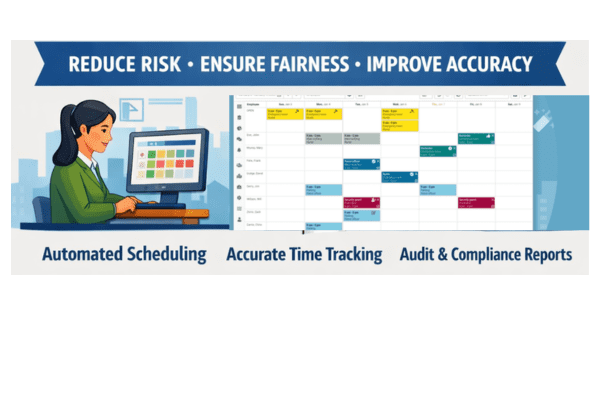

Employee scheduling is more than an operational task; it is a legal and financial responsibility. Organizations must align work schedules with labor laws governing wages, hours, rest periods, and employee protections. Failure to comply can result in fines, lawsuits, reputational damage, and employee dissatisfaction.
To help ensure compliance, organizations are turning to shift management platforms. These systems help enforce overtime and break rules, track hours accurately for payroll and audits, and adapt to predictive scheduling laws. The result is reduced legal risk, better labor cost control, and fairer schedules that improve employee well-being.
Scheduling Requirements for Employers
Labor laws define how organizations must schedule, compensate, and protect their workforce. At the core of scheduling compliance are requirements around minimum wage, overtime, and recordkeeping.
Today’s work environments, marked by shift-based roles, remote work, and flexible scheduling, have made compliance more complex than ever. Laws, regulations, and policies continue to evolve, putting strain on operations and costs.
In the U.S., compliance is not uniform with federal laws providing a baseline, and state and local laws often impose stricter requirements. Employers must always follow the most employee-protective law applicable.
Fair, Predictable Shift Scheduling
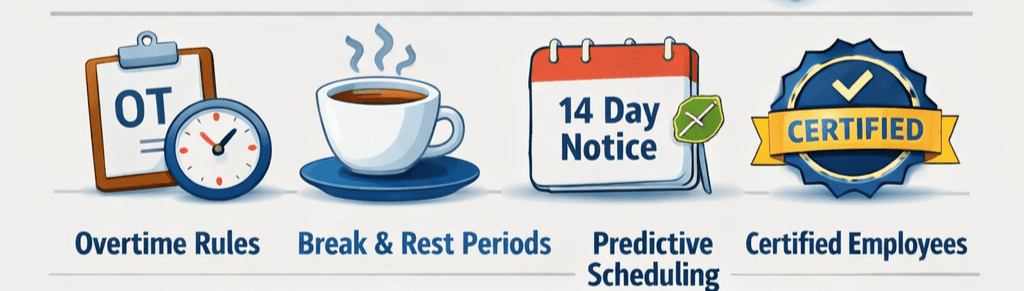
Multiple states and cities have predictive scheduling laws requiring employers to provide employees with advance notice of their work schedules, typically at least 14 days.
These laws are designed to give hourly workers more stability and control over their time, especially in industries where unpredictable schedules are the norm, such as retail, hospitality, and food service. They generally apply to hourly, minimum-wage, and non-salaried employees, especially in workplaces where on-call scheduling is a regular practice.
In addition to advance notice of shifts, predictive scheduling legislation often includes:
- Enhanced recordkeeping requirements
- Notification for potential on-call shifts
- Penalties for last-minute schedule changes
- Telling new hires how many hours they can expect to work
- Giving current employees the chance to take on more hours before hiring new staff
At its core, predictive scheduling is about fairness and transparency, ensuring workers aren’t left guessing when they’ll be working next.
Certified Employees for Valid Shift Coverage
Many organizations need to track certifications for compliance, operational readiness, safety, and to maintain their business reputation.
Employee certification tracking ensures that only qualified staff are scheduled for specific roles. This includes monitoring licenses, training, and certifications—especially those with expiration dates or compliance requirements.
Keeping certifications up to date reduces legal risk, supports audit readiness, and ensures operational reliability.
Proper Hours, Breaks, and Overtime
Another set of legal requirements for employers involves ensuring that employees get the required breaks, overtime pay, and leave.
Overtime
Under U.S. federal law, specifically the Fair Labor Standards Act (FLSA), most employees classified as non-exempt must be paid overtime at a rate of at least 1.5 times their regular rate of pay for any hours worked over 40 in a defined workweek.
Employees may be classified as exempt from overtime requirements if they meet certain criteria related to their pay and job duties, typically including executive, administrative, professional, outside sales, and certain computer roles. These are workers generally paid on a salary basis at or above a specified minimum threshold.
While the FLSA establishes nationwide minimum standards, state and local laws can impose stricter overtime requirements, such as daily overtime thresholds or additional protections.
Break Rules
Break laws refer to regulations set by federal and state governments that mandate employers to provide specific types of breaks to their employees during work hours. These laws are designed to ensure employees’ well-being, safety, and productivity by allowing them time to rest and recharge.
These laws do not universally apply to all industries or to all types of workers. They can vary by industry, the type of work performed, and whether the employee is hourly or salaried.
Family and Medical Leave
In the U.S., the Family and Medical Leave Act (FMLA) is a federal law that grants eligible employees unpaid, job-protected leave for specific family and medical reasons.
The law requires eligible U.S. employers to provide up to 12 weeks of unpaid, job-protected leave to employees who have worked at least 12 months, logged 1,250 hours in the past year, and are employed at a location with 50 or more employees within a 75-mile radius.
Employers must meet several key obligations to stay compliant. These include providing required notices (eligibility, rights and responsibilities, and designation), maintaining group health benefits during leave, and restoring employees to the same or an equivalent position upon return.
They must also properly track all types of leave—continuous, intermittent, or reduced schedule—handle medical certifications appropriately, and ensure confidentiality of employee health information.
Complete, Accurate, Timely Payments
U.S. employers must comply with a combination of federal, state, and local laws governing how employees are classified, paid, and taxed.
- Observe wage and hour laws such as minimum wage, overtime pay, and pay frequency,
- Withhold federal income tax, Social Security, and Medicare from employee wages,
- Contribute employer portions and pay unemployment taxes,
- Maintain accurate payroll records and manage deductions (such as benefits and garnishments),
- Obey laws regarding leave, final pay, and new-hire reporting.
Overall, strong systems for time tracking, payroll processing, and compliance monitoring are essential to avoid penalties and ensure accurate, lawful payroll practices.
How Employee Scheduling Platforms Help Compliance
For ops leaders, employee scheduling is no longer just about filling shifts. Staying compliant in an increasingly complex regulatory environment is essential.
Modern shift management platforms help:
- Adapt to predictive scheduling laws
- Enforce overtime and break rules automatically
- Track hours accurately for payroll and audits
- Reduce legal risk while optimizing labor costs
Compliance-first scheduling prevents violations before they occur.
It manages complex, dynamic requirements such as multi-site scheduling, certifications, fatigue rules, and on-call coverage, without stress or chaos. Schedules link directly with time tracking and payroll to reduce wage errors and compliance gaps. And provides a solid audit-ready record to prove it.
Compliance isn’t a cost for organizations that embrace rules-driven scheduling. It’s a foundation for operational excellence.
When scheduling systems enforce labor rules automatically, they create more reliable operations, better labor cost control, and fewer disruptions. The result is a stronger business: reduced risk, improved profitability, and empowered workers.
Learn More: Employee Scheduling Compliance Platform