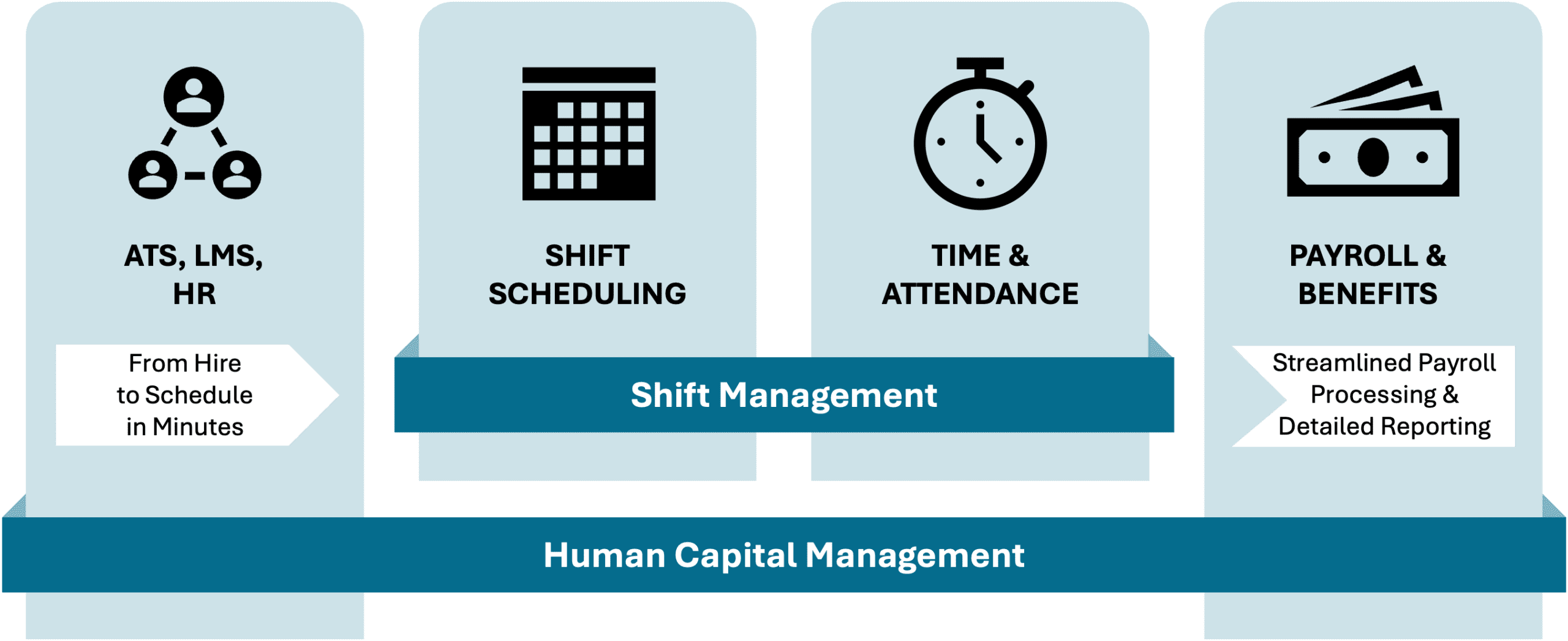

There are numerous employee scheduling and payroll systems with advanced capabilities to support automation and compliance. Specialization in one aspect of workforce management enables flexibility, control, and domain expertise that no all-in-one system can match.
But disparate systems that don’t communicate effectively can lead to data integration headaches, time-consuming manual entries, and potential compliance failures.
Unified systems enable specialized platforms to work together, automating the flow of workforce data to reduce errors and stay compliant with regulations.
Why Integration Is Critical for Compliance and Efficiency
As businesses grow, the complexity of workforce management multiplies. There are more labor laws to consider, especially if they are expanding into new areas. More employees mean more information to track, more situations to consider, and more requirements for eligibility, seniority, and other factors.
Without proper systems, there’s extra work and a risk for errors or omissions.
There can be serious consequences for non-compliance, including fines, lawsuits, and sanctions. Even if the issues don’t reach that level, grievances and employee issues can hurt morale and productivity.
Compliance with Employment Standards & Regulations
In the U.S., labor and payroll compliance are governed by a mix of federal, state, and local laws. At the federal level, regulations such as the Fair Labor Standards Act (FLSA) establish requirements for minimum wage, overtime eligibility, and recordkeeping.
Employers must also comply with tax withholding and reporting obligations through the Internal Revenue Service (IRS), as well as employment verification requirements through agencies like the Department of Labor (DOL).
However, compliance does not stop at the federal level. Many states and municipalities have their own rules covering minimum wage increases, predictive scheduling laws, paid leave requirements, and overtime thresholds.
Rules around classification, overtime eligibility and rates, and rest breaks add to the complexity. Beyond regulations, there can be union agreements, contracts, and policies that need consideration.
Systems that automatically enforce rules and flag potential violations significantly reduce the burden and risk.
Ensure Defendable Audit Trails
Compliance is essential, but proving it is equally vital.
Accurate, organized audit trails can prevent issues and grievances from becoming major problems and are a legal obligation in their own right.
Systems should store detailed tamper-proof records of time entries, schedule changes, payroll calculations, and other tracking requirements.
Generate Accurate Payroll
Errors in payroll can lead to complex reconciliation efforts, employee complaints, and financial risk. Without automated systems, there’s also the additional time and cost of manual entry.
Systems can automate the collection of employee time data, calculate complex pay rate rules, and make the appropriate adjustments. Accurate time and wage data inputs, combined with reliable synchronization, ensure precise payroll information.
Improve Operational Efficiency
Limited functionality, poor data handoffs, and miscommunication lead to duplicative or missed work.
Systems that enable each team to optimize its performance while coordinating functions maximize overall business performance.
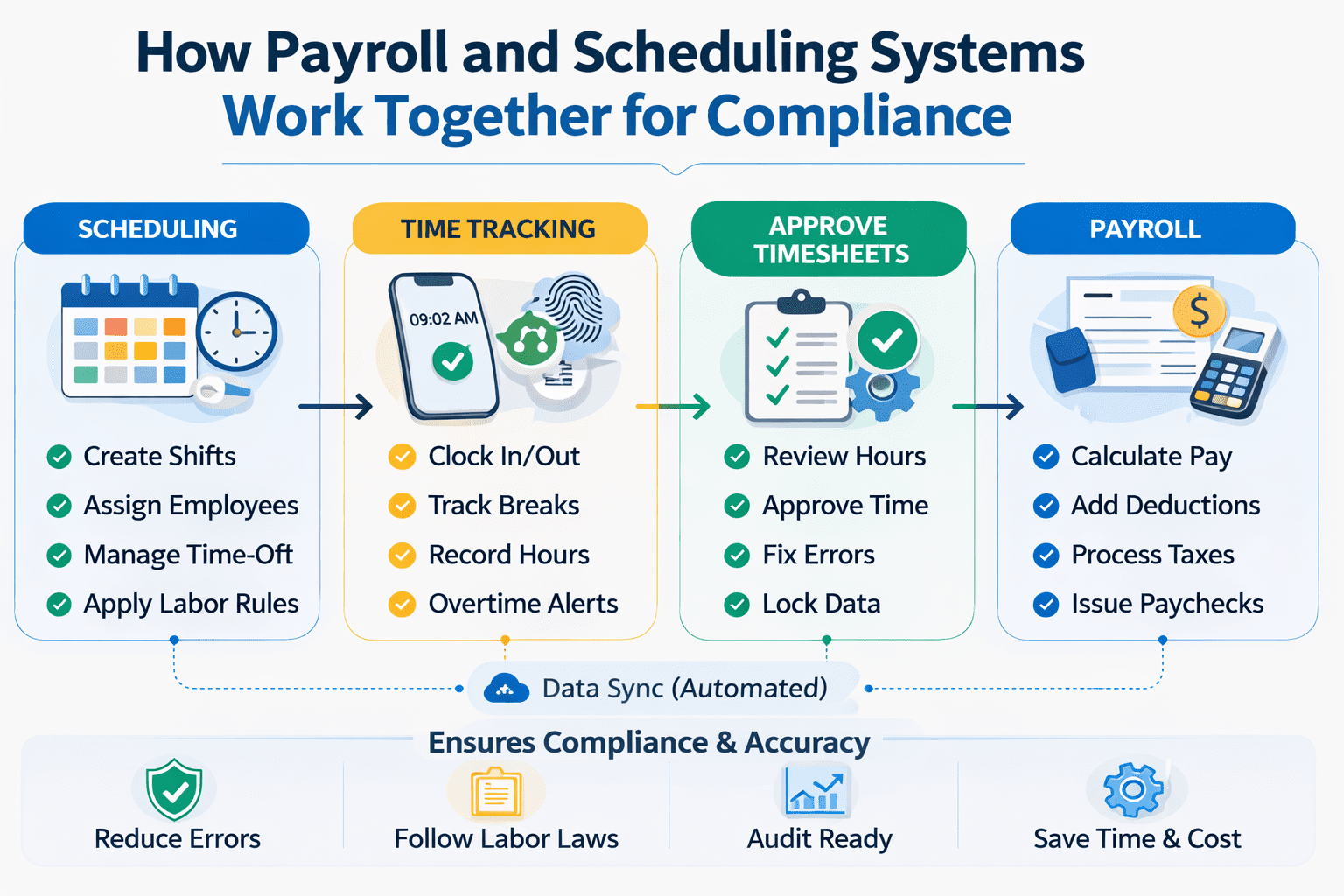
The Four Steps from Scheduling to Payroll
Different workforce functions need to align and communicate to ensure data flows accurately and smoothly.
Unified solutions enable scheduling, time-tracking, and payroll platforms to exchange data automatically via APIs or secure data synchronization.
Plan the Employee Schedule
Scheduling systems assign employees to shifts based on staffing needs, employee availability, and applicable labor rules.
They support several essential workforce management functions, including creating and managing employee schedules, enforcing rules such as maximum working hours and required breaks, tracking shift changes and overtime, and managing time-off requests.
From a compliance perspective, scheduling systems help ensure employees are scheduled according to labor laws, have the qualifications, prevent excessive overtime or missed breaks, and support fair and consistent scheduling practices across the organization.
Track Actual Work Hours
Time and Attendance systems monitor clock-in and clock-out times, breaks and meal periods, overtime hours, and any leave or paid time off taken by employees to accurately capture real-time work activity.
Accurate time tracking is critical because it serves as the primary source of data for payroll calculations. From a compliance standpoint, time and attendance systems help ensure accurate wage calculations, maintain detailed records that can support audits or legal disputes, and reduce the risk of wage and hour violations.
Approve Timesheets
After employees submit their timesheets—detailing hours worked, breaks, overtime, and leave—managers or supervisors review the entries to confirm they align with scheduled shifts, company policies, and actual attendance records. This review helps identify discrepancies such as missed punches, incorrect overtime entries, or unapproved schedule changes.
Timesheet approval serves as an important control mechanism that helps organizations verify that all hours worked are properly recorded and authorized, and creates a documented record that can support audits, labor inspections, or internal reviews.
Pay Employees Accurately
Payroll systems process time data to calculate regular and overtime pay, apply tax deductions and withholdings, and account for benefits deductions. They may also process additional payments, such as bonuses or reimbursements, before issuing compensation through direct deposits and providing employees with pay stubs.
They help ensure that deductions and withholdings are calculated correctly, minimum wage and overtime laws are applied appropriately, and detailed payroll records are generated.
Unified Solutions for Flexibility, Control, and Rock-Solid Compliance
For mid-size organizations managing multiple locations or jurisdictions, manual coordination between scheduling and payroll systems becomes increasingly risky.
A unified solution allows organizations to customize tools and services while retaining cohesion and control. Smart, transparent workflows maintain data integrity and a single source of truth that links employee shift data directly to compensation calculations.
There is one authoritative record of schedules, hours worked, and payroll calculations simplifying audits, payroll disputes, and legal evidence.
Automated Unified Workforce Management
Automations can detect coverage gaps, unauthorized shifts, unnecessary overtime, or compliance failures before they happen. All the information is instantly available to all systems, reducing manual effort, minimizing errors, and enabling deeper insights than any one system can.
The results are faster, more reliable staffing decisions, better employee communication and engagement, improved billable utilization and lower administrative costs.
Compliance is built-in. Rules are preset for actions, monitoring, and flagging, and changes can be made quickly and flow across the system.
For organizations ready to move beyond fragmented scheduling and payroll systems, a unified approach delivers what all-in-one solutions never could: clarity, control, and compliance at scale.
Learn about a Unified Solution from HR to Payroll